Faith
The Christian faith forms the cornerstone of everything that we do here at Archbishop Temple. Decisions are made based on our Christian principles which recognise the value of all members in our community, irrespective of their faith. We believe that ‘God created mankind in his own image’ (Genesis 1:27) and as such strive to fully develop all our pupils and staff in order for them to let their light shine. Our faith in God enables us to realise that ‘all things are possible’ (Mark 10:27) and so we believe that we should never give up on ourselves or each other.
Our faith is expressed and developed through regular prayer. We punctuate the days and seasons with opportunities for collective worship recognising that, ‘The Lord is near to all who call on him, to all who call on him in truth.’ (Psalm 145)
God’s light shines most brightly through grace. This message underpins all our Christian teaching showing that Christ, the light of the world (John 8:12) died and rose to freely give salvation to anyone who turns to him (John 3:16).
Nurture
We strive to nurture each person’s God given talents and gifts encouraging everyone to ‘have life and have it to the full’ (John 10:10) on this earth and in eternity. We are passionate about recognising the importance of all members of our community and understand that by working together and supporting each other we are able to make an impact for the good: ‘And let us consider how we may spur one another on toward love and good deeds… encouraging one another.’ (Hebrews 10:24).
Nurturing each other means that there will be opportunities to be part of celebrating great achievements for our pupils; it will also mean that there will be more difficult times when members of our community will need supporting (Romans 12:15). We will remember that all members of our community are created in the image of God (Genesis 1:26) and that, ‘above all, [we should] love each other deeply because love covers a multitude of sins.’ (1 Peter 4:8-11).
Service
As a community we recognise the importance of serving others, both those within our school, within our local community and the wider world. We believe that ‘whoever wants to be great must become a servant’ (Mark 10:43), and this transforms lives for the better. We recognise that serving others is an opportunity to put our faith into action: ‘Faith by itself, if it is not accompanied by action, is dead’ (James 2:17) and through good deeds we have the opportunity to glorify God.
Throughout school pupils will get a variety of opportunities to serve; for example, through supporting charity events and through taking on roles of responsibility. Pupils will be encouraged to think about the different ways in which they can carry out good deeds and become independent in the ways that they do this: ‘Each of you should use whatever gift you have received to serve others, as faithful stewards of God’s grace in its various forms.’ (1 Peter 4:10)
At Archbishop Temple Church of England High School, spirituality is at the heart of who we are.
Rooted in our Christian vision:
"Through faith in God the Father, Son and Holy Spirit, we nurture everyone's God-given gifts so that together we may shine God's light through Christ-like service," we believe that every person is uniquely created, valued and loved by God, and has the potential to flourish.
Inspired by Jesus' promise that he came so that all may "have life, and have it to the full" (John 10:10), we understand spirituality as an essential part of human flourishing. Spirituality is not limited to religious belief; it is a natural dimension of being human and is therefore open to everyone, regardless of faith or worldview. It is about how we make sense of ourselves, our relationships, our experiences and the world around us as we search for meaning, purpose and connection.
Here at school we aim to make our acts of worship inclusive, inspirational and invitational. Each year group attends collective worship throughout the week. Tutors also lead their Form Group to further explore the theme through activities, games, discussions and prayers or will have a liturgical service of their own lead our form worship. Throughout the worship schedule we observe the seasons and principal feasts of the Church of England calendar providing a great opportunity to learn about the life of Jesus. This also helps to link with our Diocese and Deanery churches who follow the same pattern.
Our team ethos ensures a collaborative approach to our worship schedule which provides an opportunity for the pupils to hear from several members of staff, including the Headteacher, Senior Leadership Team, Pastoral Leaders, RE Department and other teachers. It is also exciting when guests come into school from our Diocese links and local churches to lead worship.
We arrange other ways to express our worship throughout the life of the school, for example, we have staff prayer and communion gatherings based in the chapel and members of the staff team lead a reflection during the morning briefing time. Our pupils are invited to the chapel once a week for a Christian Union lunch club to enjoy fellowship and be encouraged from God’s word. The chaplain coordinates this group along with regular help from local youth workers and ministers.
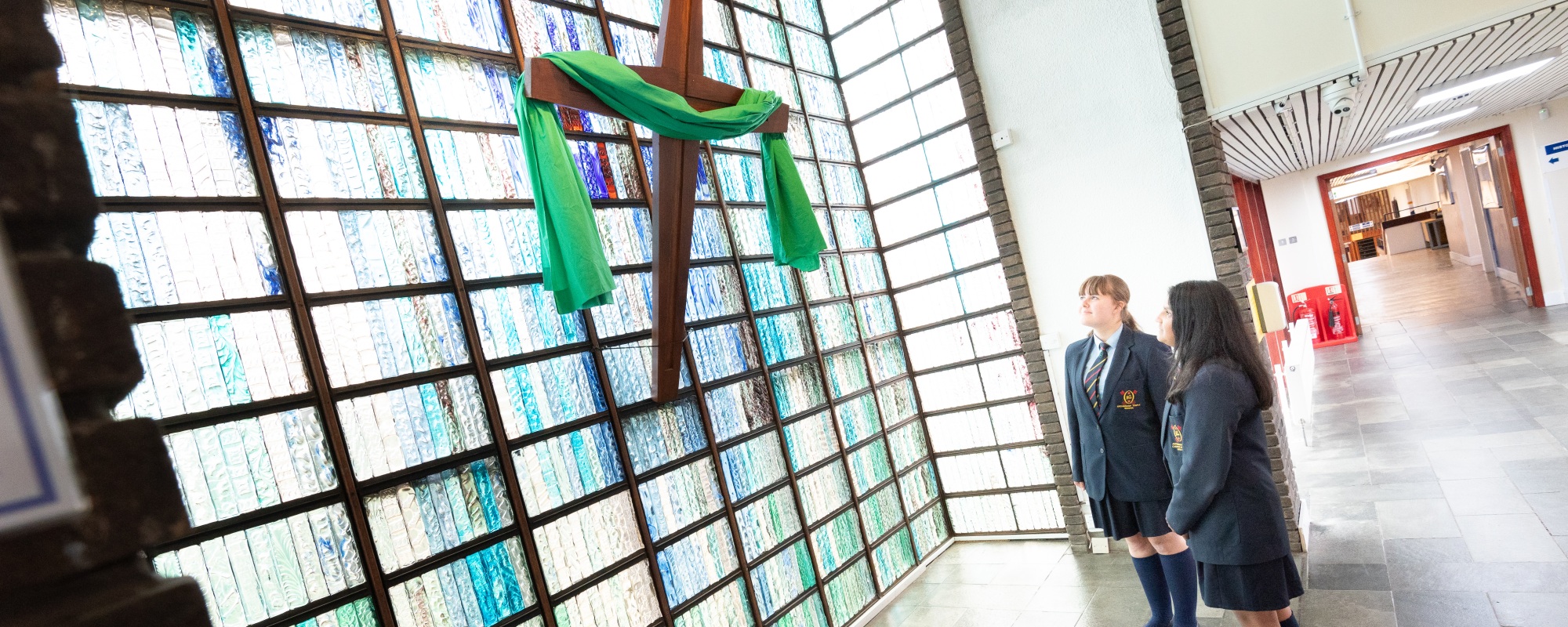
The chapel is usually a quiet space reserved for reflection and connection with God. It is used for a range of activities including, individual reflection, form group communion, Christian lunch clubs, Alpha groups, staff prayer, prayer spaces and RE classes.
We’re always keen to develop our community links and opportunities for our staff and pupils to engage in worship activities so please feel free to email our chaplain if you would like to serve in any way.
The school prayer came from the reviewing and re-writing of the school’s vision. Pupils played the main part in creating the prayer, as well as staff and governors, and it is said regularly throughout the week. The school song came after this and is sung regularly in collective worship as well as at other times such as staff inset days, and school trips.
School Prayer
Heavenly Father,
Bless us with courageous faith in you.
Help us to nurture everyone’s gifts and talents.
Inspire us in Christ-like service of others.
May we know your love, share your life and radiate your light.
We pray this in the name of the Father, Son and Holy Spirit.
Amen
School song
Shine God’s Light
Verse 1
We may be scared of the unknown
And we may fear what we can’t control
But take a minute to see your potential,
The possibilities
Of everything you’re designed to be
Chorus
In all that we do, we’ll shine God’s light
Striving to always do what’s right
Living our future brightly, for all the world to see
I’m treading the careful path that God has given me
To be the best that I can be
Verse 2
We know that Jesus is our King,
His Heavenly praises we will sing.
We will help each other in his likeness,
When there’s a friend in need.
For within God’s love, we will succeed
Chorus
In all that we do, we’ll shine God’s light
Striving to always do what’s right
Living our future brightly, for all the world to see
I’m treading the careful path that God has given me
To be the best that I can be
Bridge
Don’t let anybody dull your sparkle
Don’t let anybody take your faith away
For when things get tough, we’ll always try to
Find a way
Chorus
Shining God’s light in all we do
Having the faith to see things through
Living our future brightly, so all the world will see
I’m trusting the careful plan that God has given me
To be the best that I can be (x3)

The Chapel – A Space for Worship, Reflection and Community

The school chapel is at the heart of our spiritual life and provides a calm, welcoming and inclusive space for pupils and staff of all faiths and none. The chapel provides opportunities for pupils to encounter and reflect upon the school's Christian vision, considering how faith, nurture and service can be lived out in daily life. While deeply rooted in the Christian tradition, the chapel is an inclusive space where pupils of all faiths and worldviews are encouraged to reflect, ask questions and contribute their own perspectives.
The chapel is used regularly for a wide range of worship, reflection and pastoral support, helping to further develop the school’s Christian ethos of faith, nurture and service. Through worship, prayer and reflection, pupils are encouraged to explore what it means to live well together, recognising the dignity and worth of every person as made in the image of God.

Throughout the week, the chapel is used for collective worship, small group reflection, and themed services linked to the school’s Christian values and the liturgical calendar. Every Tuesday morning, Form Group Eucharist is celebrated with one of the local vicars, providing pupils with opportunities to engage with Anglican worship and deepen their understanding of Christian belief and practice.
Pupils are invited to engage with a range of prayer opportunities, including prayer stations, reflection spaces and collective acts of prayer that encourage personal and communal spirituality. Pupils take an active role in shaping chapel life through leading prayers, planning reflective activities and contributing to worship, helping them develop confidence, responsibility and spiritual leadership.
The chapel provides regular opportunities for pupils to engage with life's big questions, explore meaning and purpose, and reflect on their own beliefs and values. The weekly Ignite group provides a dedicated space for pupils to explore these issues together.
The chapel also plays an important role in supporting teaching and learning in Religious Education with pupils taking part in interactive prayer stations, reflective activities, and structured worship experiences that deepen their understanding of faith, belief, and spirituality. Chapel sessions for other subjects led by Chaplain Jo also take place in the chapel. For example, pupils engage in guided reflection on personal identity to complement the Year 7 English unit on Identity.


In addition to formal worship, the chapel is a space where pupils can encounter silence, peace, and reflection. It is open during the school day as a sanctuary space where pupils may come during social times. Here, they are able to meet friends, enjoy quiet conversation, or simply spend time in a calm and restorative environment. The space is supported by sympathetic adult oversight, ensuring it remains safe, respectful, and welcoming for all.
Importantly, the chapel also serves as a place of pastoral care. Pupils are welcome to come when they are feeling upset, angry, overwhelmed, or simply in need of time and space away from the busy school environment. It offers a listening presence and a sense of stability, where pupils can pause, reflect, and be supported if needed.
This provision reflects the school's commitment to recognising the dignity of every individual and ensuring that all members of the community are supported to flourish emotionally, socially and spiritually.
Many pupils identify the chapel as a place of belonging, peace and support, where they feel valued, listened to and encouraged to reflect on their own spiritual journey.
Whether used for worship, teaching, quiet reflection, or informal social time, the chapel is a distinctive and valued part of school life. It stands as a visible sign of the school’s commitment to caring for the whole person, spiritually, emotionally, and socially and remains open as a place of welcome for all.
My name is Joanne Phipps and I am the chaplain at Archbishop Temple Church of England High School. I started this role in early June 2024. The pupils call me Chaplain Jo or just Jo for short.
I’ve worked in education as a teacher for 28 years, covering multiple subjects and key stages. I am excited about my role as chaplain as this gives me an opportunity to support the distinctive Christian Ethos of the school whilst pastorally working with pupils who are going through challenging life circumstances or who are facing difficulties that can affect their attitude to learning or confidence and self-esteem.
I passionately believe that Christian faith is transformative, leading to “life in all its fullness” John 10:10, and that in receiving a Christian education pupils will have the confidence to let their light shine before others. A Christian education allows students to grow in faith and will see themselves as a full and valued part of a community that serves others as Christ has served us. Our community really puts Christ at the centre of everything that is done here, that every person is known by name and valued as a beloved child of God.
It is a blessing to be part of a school committed to our Christian roots and following the words of Jesus. As we work closely with the Blackburn Diocese Board of Education, including the chaplaincy network, we seek to implement their Vision in our context. My role here is to encourage this Vision and our Christian ethos into the whole of school life in such a way that is accessible for everyone.
The Vision is to see children and young people transforming the world through the love of Jesus and in the power of the Holy Spirit. The Mission is to help build worshipping and prayerful children and young people that love Jesus and want to follow Him, and who live out their faith in communities, in friendships and in families.
We aim to provide an environment where everyone here feels included to explore faith, ask questions and express their ideas as we journey together. In pursuit of that goal, I help to coordinate and deliver our daily acts of worship, chapel time, faith based clubs and I also enjoy getting involved in all other areas of school life. I believe that in being a chaplain I should be visible, active, accessible and present.
I am also available for 1:1 pastoral support for staff and pupils if ever they may need a listening ear during difficult times that can occasionally affect us all, these are arranged by contacting me directly or through our pastoral tutors and team via the contact form on out school website.
If you would like to ask me any questions please don’t hesitate to contact me.
Jo Phipps
Chaplain
Our Faith Reps are responsible to help lead and coordinate our times of collective worship. They are on a rota to begin and end the liturgy when we meet in the main hall. They will also prepare for readings in their form group chapel communion. We will gather Faith Reps together occasionally for pupil feedback which gives them a chance to give suggestions to improve.
A key feature of our Christian vision is the work of our School Chaplain who is responsible for coordinating all daily worship activities and is available each day to listen and give support to all members of the school community. Pupils in our school are undertaking the Archbishop of York Youth Trust Young Leaders' Award as a way of giving something back to our community.
Pupils from Archbishop Temple School talk about the Archbishop of York Youth Trust Young Leaders' Award.

Pupil Council – Outreach to the local community
Throughout the year, our Pupil Council have been working so hard within school, acting as a voice for all pupils and ensuring our school is a positive place for all. The Pupil Council feel it is part of their role to ensure they represent each member of our school community, and are dedicated to playing a part in their involvement and enjoyment in school life, both within and beyond the classroom. Our school scripture reminds us to ‘Let your Light Shine’, which is at the heart of all the Pupil Council do.
This year, they have dedicated some time to explore their commitment to make a positive difference beyond our school, and outreach to the local community. The Pupil Council shared a passion to reach out to those who may be considered vulnerable or in need. We discussed how this links with our school motto, in particular ‘service’. Exploring this possibility gave us the opportunity to discuss how charities operate, whilst focusing particularly on those close to our school community.
We were particularly drawn to the charity, Blue Flamingo, which operates at a range of venues, one of which is a nearby church, St Michael and All Angels, Ashton, Preston. The main aim of the Blue Flamingo is to support those both living with dementia, and those who care for them.
All the pupil’s hard work and determination soon came to fruition and strong links have been formed between our Pupil Council and the Blue Flamingo. Pupil Council members now attend the café at St Michael’s Church, Ashton, on a regular basis. Pupils spend time talking to members of the café, playing games with them and ensuring they all have a nice warm brew! It is truly heartwarming to see how our pupils interact with members of this lovely, welcoming community. Each and every pupil shows patience, care and compassion as they spend quality time with them. Our Pupil Council members gain so much from this experience, and leave each session with lovely stories to share.
As a Christian community, we feel it is a privilege to be involved with an organisation such as this, whose values are truly in line with those of Jesus – an inclusive, compassionate and joyous place, where all are welcome and supported.



Inspiring Children and Young People
This fourth strand of Vision 2026 is led by the Diocesan Board of Education (DBE) and seeks to both inspire children and young people to be avid followers of Christ and to be inspired by them as they develop as disciples, witnesses and leaders. The work of the DBE includes engaging with church schools, children’s and young people’s work in churches and in chaplaincy at schools and universities.
The Vision is to see children and young people transforming the world through the love of Jesus and in the power of the Holy Spirit. The Mission is to help build worshipping, discipling and prayerful children and young people that love Jesus and want to follow Him, and who live out their faith in communities, in friendships and in families.
The ‘Inspiring Children and Young People’ Vision 2026 theme has the following priorities:
- Nurturing Children and Young People in their Faith and Supporting them as Disciples of Jesus Christ
- Holding Regular Worship that is Accessible and Appealing to Children, Young People and their Families.
- Enabling Growth in the Numbers of Leaders of Children and Young People
- Pursuing a Step Change in work with those aged 11-16
- Facilitating Effective Partnerships between Churches and Local Schools
Much more detail is available here and via the DBE web pages where you can discover more about work with schools, children and young people in our parishes.
The Diocesan Vision Prayer
Heavenly Father, we embrace Your call for us to make disciples, to be witnesses, to grow leaders and inspire children and young people. Give us eyes to see Your vision, ears to hear the prompting of Your Spirit and courage to follow in the footsteps of your Son, our Lord and Saviour Jesus Christ.
Amen
 About Archbishop William Temple
Introduction:
Archbishop Temple Church of England High School takes its name and inspiration from William Temple, one of the most influential Christian leaders of the twentieth century. Temple was not only Archbishop of Canterbury, but also a passionate advocate for social justice, education, and the dignity of every individual. He believed deeply that faith should be lived out in action — shaping communities, challenging inequality, and enabling all people to flourish.
Our Christian distinctiveness reflects this legacy. Just as William Temple worked to break down barriers and champion the common good, we are committed to nurturing every member of our school community, recognising the value of each person as created in God’s image. Faith is not simply something we teach, but something we live: guiding our decisions, shaping our relationships, and inspiring us to serve others with compassion, hope and integrity.
In this way, the vision of William Temple continues to influence and inspire all that we do, as we strive to let God’s light shine through faith, nurture and service.
Continue reading for more information about William Temple, including some of the significant things he said.
‘Archbishop William Temple was undoubtedly one of the great men of the twentieth century. The issues with which he concerned himself – social welfare for all, education, ecumenism and evangelism – remain at the heart of the Church’s life today. William Temple had immense gifts and, not least the ability to overcome the barriers of class, Christian denomination and political allegiance. He was recognised as both a man of God and a man of the people. Most of those who met him were inspired by the encounter.’ (Bishop Alan Blackburn in the Foreword to WILLIAM TEMPLE: A Calling to Prophecy by Stephen Spencer)
Archbishop William Temple (1881-1944) was a remarkable and influential man. As a school, we should be very proud to be named after him. He was Bishop of Manchester, then Archbishop of York before becoming Archbishop of Canterbury in 1942.
When he became Archbishop of Canterbury, the country was facing many difficulties, especially the continued threat of Nazi aggression. At that very dark time during the Second World War many people were expecting and fearing a Nazi invasion, and Archbishop Temple was a leader who encouraged people to hope.
Archbishop Temple also publicly supported Jewish people at a time when anti-Semitism was widespread, and the persecution of the Jews under Hitler was at its height. He co-founded an organisation called the Council of Christians and Jews (CCJ) which is still a powerful organisation supporting interfaith dialogue.
However, Archbishop Temple is probably best known for his work for social justice. He believed in the rights of all people, whether they are rich or poor. He also was a driving force for the 1944 Education Act, which provided free education to all children. Archbishop Temple believed that human freedom depended on society as a whole, in particularly the state having a positive role through education to equip people properly for a purposeful and creative life in which they could play their part in moving society forward.
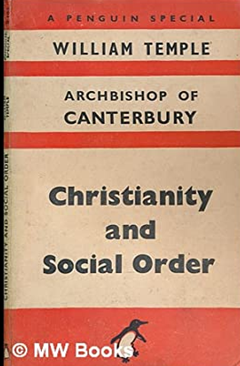 In 1942, Temple wrote Christianity and Social Order. In it he encouraged Christians to call upon Government to prioritise certain things, such as:
- Every child should be a member of a family housed with decency and dignity, so that they could grow up happily and unspoilt by underfeeding or over-crowding or by dirty and drab surroundings.
- Every child should have the opportunity of an education in order to develop fully. This education should throughout be inspired by faith in God and find its focus in worship.
- Every citizen should have sufficient leisure time, with two days of rest a week and if an employee, annual paid-leave in order to enable them to have a full personal life and opportunity to develop interests and talents.
- There should be freedom of worship, speech, assembly and of association for special purposes. (Temple, 1950, (1942), p.99)
 One of the practical things that Archbishop Temple did was to create the Diocese of Blackburn, the diocese in which our school and local churches reside. He was Bishop of Manchester at the time but this diocese was getting too big and difficult to manage. He looked at options for creating a cathedral in Preston, Lancaster and Burnley but opted for Blackburn. There were many practical reasons for choosing Blackburn over the other areas including the train links and the potential to develop the church which would then become the cathedral.
So as a school we are named after a very special person, and we would do well to remember his work to bring about justice to different groups of people. But his life’s work was firmly based in his Christian faith. He summed up his beliefs, and that of other Christians, in these words.
“My worth is what I am worth to God; and that is a great deal, for Christ died for me.”
|
In 1965 Mrs Frances Temple was asked by the then Chair of Governors of William Temple School to recall her husband’s favourite Bible verse. In her letter of reply she says, “The text that comes to mind is one he quoted to me one August day when we were looking down on the loveliness of Buttermere Lake. I cannot remember where to find it – so can only quote from memory. “Eye hath not seen, nor ear heard, neither hath it entered into the heart of man what good things God hath prepared for them that love him”. We were having a picnic looking at Buttermere and we were talking about the future life – and he went on to say, “if it’s something better than this then it must be pretty good”. “No eye has seen, no ear has heard, and no human mind has conceived the things God has prepared for those who love him.” (1 Corinthians 2:9) |
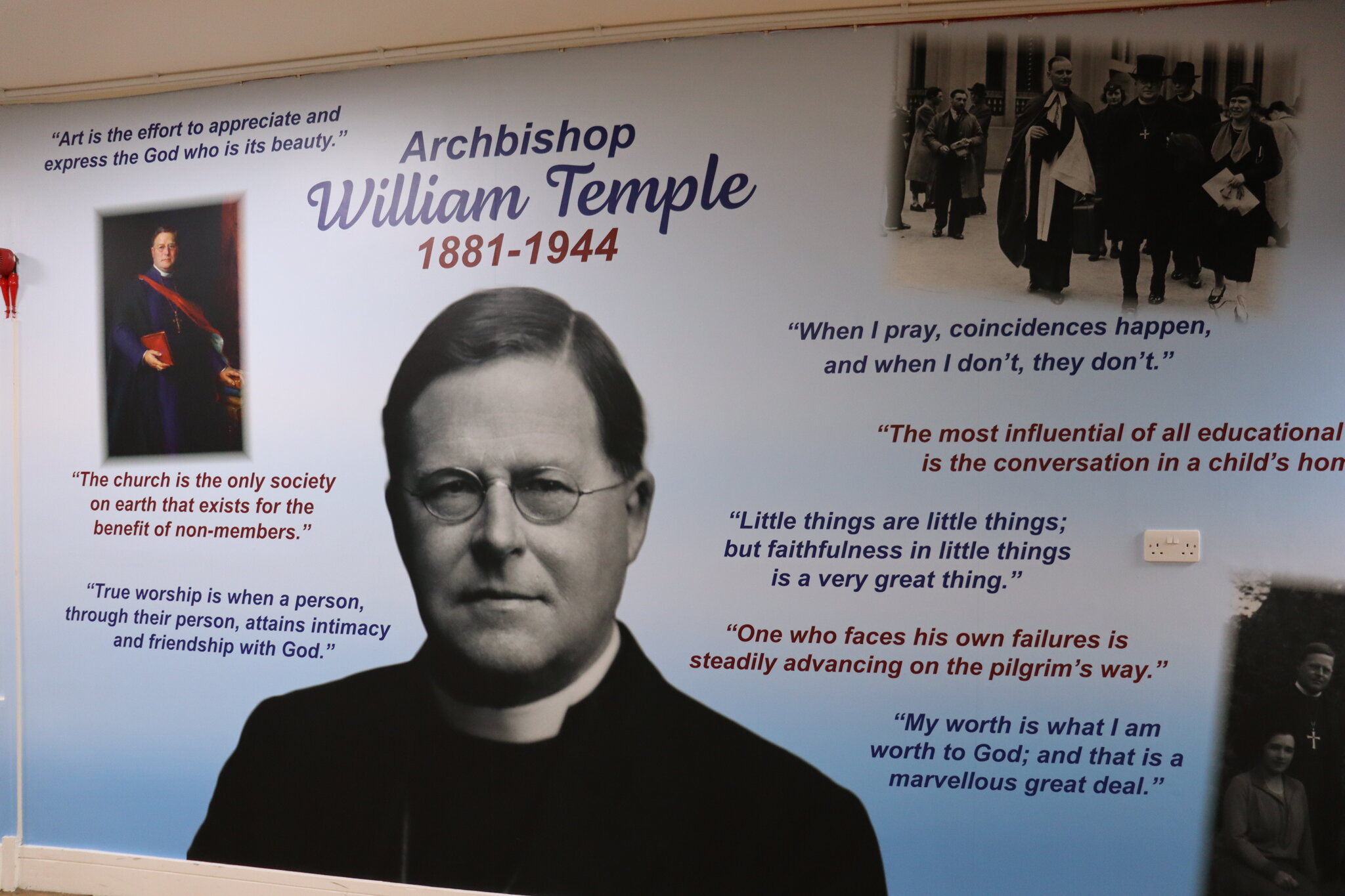
Archbishop William Temple said many wise things, a large display in school (pictured above) reminds us of them. Here are some more of the quotes that are attributed to him:
Worship and Faith
When I pray, coincidences happen, and when I don't, they don't.
To worship is to quicken the conscience by the holiness of God, to feed the mind with the truth of God, to purge the imagination by the beauty of God, to open the heart to the love of God, to devote the will to the purpose of God.
True worship is when a person, through their person, attains intimacy and friendship with God.
We shall say without hesitation that the atheist who is moved by love is moved by the Spirit of God; an atheist who lives by love is saved by his faith in the God whose existence (under that name) he denies.
The Church is the only society that exists for the benefit of those who are not its members.
Character and Life
The first ingredient in conversation is truth, the next good sense, the third good humour, and the fourth wit.
Humility does not mean thinking less of yourself than of other people, nor does it mean having a low opinion of your own gifts. It means freedom from thinking about yourself at all.
The best rules to form a young man are: to talk little, to hear much, to reflect alone upon what has passed in company, to distrust one's own opinions, and value others that deserve it.
A man's wisdom is his best friend; folly, his worst enemy.
The greatest medicine is a true friend.
The greatest pleasure in life is love.
Little things are little things; but faithfulness in little things is a very great thing.
Art is the effort to appreciate and express the God who is its Beauty.
Science has its being in a perpetual mental restlessness.
The most influential of all educational factors is the conversation in a child's home.
One who faces his own failures is steadily advancing on the pilgrim's way.
Our School Badge

The school opened in 1963 and the school badge has been the same design since its opening.
The badge combines the symbols from the coat of arms for the Blackburn Diocese and Preston.

The Blackburn Diocese arms were officially granted on February 19, 1927.
The arms combine the crossed keys of St. Peter with the rose of Lancashire, where the diocese is situated. Aside from our school being geographically located in the Blackburn Diocese, William Temple actually created the diocese when he was Bishop of Manchester.

The Preston coat of arms includes the lamb. This is a symbol which is seen lots in religious iconography. One of the terms used to talk about Jesus is Lamb of God. This links with how animals were often sacrificed to show devotion to God. Christians believe that Jesus’ death on the cross was the ultimate sacrifice and shows that there was no need for any future animal sacrifices.
The lamb is also the coat of arms for St Wilfrid, the patron saint of Preston. St Wilfrid was involved in spreading Christianity from about 664 AD to his death in 709 AD. St Wilfrid is said to have donated land upon which Preston was founded – Priest Town. (Preston – from Anglo-Saxon Preost Tun – means settlement of the Priest). Some even think that St Wilfrid was the person who brought Christianity to Preston during Anglo-Saxon times.
Until the Reformation, Preston parish church was dedicated to St Wilfrid. Then came a name change to St John’s, and now it is referred to as Preston Minster. St Wilfrid’s became the name of the Roman Catholic church in Chapel Street, which leads off Fishergate into Winckley Square.
Many people think that the PP on the logo means Proud Preston. However, the origins are likely to have been Princeps Pacis - Prince of Peace, again a reference to Jesus and possibly showing that Jesus is the protector of the city. The PP has gradually evolved to be locally known as Proud Preston.