Subject: Design and Technology
CURRICULUM INTENT
Subject: Design and Technology

CURRICULUM INTENT
Design and Technology is a creative and practical subject that enables pupils to become confident, independent learners who can identify problems, analyse needs and apply knowledge and skills to design and make purposeful outcomes. The curriculum affirms pupils’ creativity, identity and potential, preparing them to engage thoughtfully and responsibly with the technological world.
The department’s motto Saw It – Draw It – Sew It – Cook It reflects the distinct yet connected disciplines of Graphic Design, Resistant Materials, Textiles and Food and Nutrition. Engaging, hands-on learning captures pupils’ imaginations and challenges them to solve real-world problems, equipping them with transferable skills for further study and life beyond school. The curriculum is designed to reduce barriers to learning. Explicit instruction, live modelling, structured scaffolding and vocabulary support ensure all pupils can access knowledge and practical experiences. As confidence and competence grow, scaffolds are gradually withdrawn so pupils can work independently and master key skills.
The curriculum is designed so that pupils build secure knowledge and practical capability over time. Through purposeful designing and making, pupils learn how materials, processes and systems work, why design decisions matter, and how technology shapes individuals, communities and the wider world. This secure foundation enables clear progression within Design and Technology and prepares pupils effectively for Key Stage 4 and further technical pathways.
Across Key Stage 3, pupils develop a coherent sequenced body of disciplinary knowledge, including:
- materials and ingredients and their properties, including timbers, polymers, textiles and food
- processes, tools, equipment and techniques used in making, manufacturing and food preparation
- principles of design, user-centred thinking and problem solving
- following, understanding and adapting recipes, including nutrition and meeting different user needs
- sustainability, ethics and the social, moral and environmental impact of design and technology, including food provenance and responsible sourcing
- the work of designers, technologists and food professionals, and the influence of culture and tradition on designed and made outcomes
Pupils progressively develop technical, creative and evaluative skills, learning to:
- work safely and accurately with hand tools, machinery, specialist equipment and CAD/CAM to design and manufacture quality outcomes
- work safely and hygienically with food preparation equipment and kitchen systems, applying good food safety and organisation
- communicate, plan and refine ideas effectively through sketching, modelling, and graphical techniques as part of an iterative design process
- plan, prepare, test and refine recipes, making informed decisions about nutrition, user needs and quality
- evaluate and test outcomes, applying aesthetic, economic, moral, social and technical value judgements, including nutritional quality, sustainability and user needs
Pupils are encouraged to take risks, learn from mistakes, and grow in resilience and independence. Through reflection, feedback, and purposeful practice, pupils develop wisdom, understanding, and confidence in their learning.
Rooted in our Christian vision, Design and Technology helps pupils recognise their God-given talents and use them responsibly. Pupils are encouraged to design and make with integrity, to care for creation through sustainable choices, and to consider the impact of technology on people, communities, and the environment. Inspired by the biblical example of craftsmanship:
“He has filled him with the Spirit of God, with wisdom, with understanding, with knowledge and with all kinds of skills…”
Exodus 35:31–33
Through Design and Technology, pupils leave Archbishop Temple as reflective, skilled individuals equipped with practical, creative, and problem-solving skills for everyday life, future study, and careers in design, manufacturing, and food preparation.
IMPLEMENTATION
|
|
|||
|
Year |
Health and Hygiene
|
Skills |
Knowledge |
|
Y7 |
Basic hygiene practices (hand washing, food storage) |
Introduction to knife safety and basic cutting techniques (e.g., bridge, claw, dicing) |
Understanding of food groups and balanced diet |
|
Y8 |
Understanding cross-contamination and safe food handling |
Intermediate knife skills (e.g., dicing, julienne, chiffonade) |
Knowledge of macronutrients (carbohydrates, proteins, fats) and their functions |
|
Y9 |
Advanced hygiene practices (e.g., sanitising surfaces, proper cooking temperatures) |
Advanced knife techniques (e.g., filleting, deboning) |
Understanding of micronutrients (vitamins, minerals) and their importance |
|
Y10 |
Application of hygiene practices in complex cooking scenarios |
Mastery of knife skills and accuracy when cutting |
In-depth knowledge of dietary needs for different populations (e.g., children, athletes) |
|
Y11 |
Comprehensive hygiene management in food preparation and presentation |
Proficient use of knife skills and other kitchen equipment, demonstrating confidence, precision, and the ability to apply skills effectively in various task |
Advanced nutrition planning and analysis for specific dietary requirements |
|
|
Students’ progress from basic hygiene practices to comprehensive hygiene management. |
Development from basic knife skills to proficiency in using advanced kitchen tools demonstrating a high level of precision, technique and presentation quality. |
Understanding of nutrition evolves from basic food groups to advanced nutrition planning for specific dietary requirements. |
|
Graphic Products and Resistant Materials
|
|||
|
Year |
Health and Safety
|
Skills |
Knowledge |
|
Y7 |
Basic workshop safety rules (e.g., wearing PPE, safe tool handling) |
Introduction to basic workshop tools (e.g., coping/tenon saws, hand files, hand drills) and turning 2D designs into 3d Objects (perspective, oblique, isometric) |
Properties and uses of common timbers, card/paper and polymers |
|
Y8 |
Understanding risk assessments and safe working practices |
Intermediate tool skills (e.g., soldering irons, fret saw/disc sander, pillar drill) and developing intermediate drawing (rendering, CAD) |
Knowledge of different types of timber (hardwood, softwood) and polymers (thermosets/thermoplastics) |
|
Y9 |
Advanced safety procedures (e.g., machine safety, emergency procedures) |
Advanced tool techniques using correct equipment to solve the problem (CAD/CAM, laser cutter) and advanced drawing (Orthographic, CAD/CAM) |
Detailed understanding of timber, polymer and card properties |
|
Y10 |
Application of health and safety in complex projects |
Mastery of cutting and finishing tools, including power tools with increased accuracy and |
In-depth knowledge of material selection and properties depending on specialism |
|
Y11 |
Comprehensive safety management in project work |
Proficient use of hand tools and machinery, demonstrating confidence, precision, and the ability to apply skills effectively in various task |
Advanced material analysis and application in design and manufacturing |
|
|
Safety starts with basic workshop rules and advances to comprehensive safety management |
Development from basic use of saws to proficiency of machining using fret saws, to laser cutters and advanced 3d printing |
Knowledge of materials deepens from basic properties of common timbers, cards and papers to advanced material analysis and manufacture |
|
Textiles
|
|||
|
Year |
Health and Safety
|
Skills |
Knowledge |
|
Y7 |
Basic safety rules (e.g., using scissors, needles safely, avoiding sharp objects) |
Introduction to basic textiles tools (e.g., scissors, needles) and their safe use |
Properties and uses of common fabrics and fibres |
|
Y8 |
Understanding safe working practices (e.g., handling sewing machines, avoiding burns from irons) |
Intermediate tool skills (e.g., sewing machine basics, hand stitching) and their safe use |
Knowledge of different types of fabrics (natural vs. synthetic) and their properties |
|
Y9 |
Advanced safety procedures (e.g., machine maintenance, safe ironing techniques) |
Advanced tool techniques using correct equipment to solve the problem (e.g., overlocking, pattern making advanced stitching) |
Detailed understanding of fabric properties and advanced fibres (e.g., blends, specialty fabrics) |
|
Y10 |
Application of health and safety in complex projects |
Mastery of cutting and finishing tools, including advanced sewing techniques with increased accuracy |
In-depth knowledge of material selection and properties for specific textile applications |
|
Y11 |
Comprehensive safety management in project work |
Proficient use of sewing and machinery, demonstrating confidence, precision, and the ability to apply skills effectively in various task |
Advanced material analysis and application in textile design and manufacturing |
|
|
Safety practices begin with basic rules and advance to comprehensive safety management |
Development from basic use of scissors and needles to proficiency of sewing machines, pattern making and advanced sewing techniques |
Understanding of fabrics progresses from basic properties to advanced material analysis and application in textile design and manufacturing |
Within the three areas of Design and Technology at Key Stage Three, all lessons are tailored in supporting the needs and ability levels of the pupils. At Key Stage Four pupils have the opportunity to specialise in a particular area of Design and Technology: Textiles, Graphic Products, Resistant Materials and Food Preparation & Nutrition. All areas are taught by specialist teachers and are taught in subject specific rooms.
Programmes of Study
Year 7
Textiles
Health and safety, making materials and fibre investigation.
Product Design
Drawing skills, introduction to computer aided design, Health and safety and developing independence and accuracy with workshop tools.
Food and Nutrition
Hygiene and Safety, healthy eating guidelines, macronutrient and micronutrients, Introduction to food preparation and cooking skills.
Year 8
Textiles
Colour application, investigation into other cultures and creating a 3D made product.
Product Design
Mechanisms and forces, computer aided manufacture and user centred design. Embedding skills and knowledge in workshop machinery to produce three dimensional products.
Food and Nutrition
Multicultural cuisines, dough and sauce investigations and food provenance.
Year 9
Textiles
Construction in Fabric Project, construction of a product from sustainable sources.
Product Design
Functionality, aesthetics, ergonomics and anthropometrics. Utilising workshop tools and machinery to produce three dimensional products.
Food and Nutrition
Food science and investigation, composite meals and nutrition.
Click here to view the Year 9 Options information for Design and Technology.
Click here to view the Year 9 Options information for Food Preparation and Nutrition.
Year 10
At Key Stage 4, pupils have the opportunity to specialise in a particular area of Design and Technology: Textiles, Graphic Products, Resistant Materials and Food Preparation & Nutrition.
Design and Technology; Textiles, Graphic Products and Resistant Material specialisms
Pupils will study core technical principles as well as specialist subject specific practical projects and theory during this year, which include;
Core technical principles - to extend the pupils knowledge and understanding of the subject and gain a breadth of core technical knowledge and understanding. This will help to make informed decisions when designing.
Specialist technical principles – pupils should develop an in-depth knowledge and understanding of specialist technical principles including: selecting materials and components – forces and stresses – ecological and social footprint – sources and origins - selection of materials or components - using and working with materials - stock forms, types and sizes - scales of production - specialist techniques and processes - surface treatments and finishes.
Designing and Making Principles - Students should know and understand that all design and technology activities take place within a wide range of contexts. They should also understand how the prototypes they develop must satisfy wants or needs and be fit for their intended use. For example, the home, school, work or leisure. They will need to demonstrate and apply knowledge and understanding of designing and making principles in the completion of a design and make piece of coursework.
Food Preparation and Nutrition
Pupils can also opt for GCSE Food and Nutrition. The course equips students with the knowledge, understanding and skills required to cook and apply the principles of food science, nutrition and healthy eating. It encourages learners to cook, enables them to make informed decisions about food and nutrition and allows them to acquire knowledge in order to be able to feed themselves and others affordably and nutritiously, now and later in life.
During year 10 pupils will complete a series of written projects as well as food practical projects that concentrate on enhancing pupils’ skills and understanding in twelve keys areas of assessment;
General Practical Skills
Knife Skills
Preparing Fruit & Veg
Cooker Skills
Using Equipment
Cooking Methods
Prepare Combine Shape
Sauces
Tenderised & Marinate
Dough
Raising Agents
Setting Mixtures
Year 11
Design and Technology; Textiles, Graphic Products and Resistant Material specialisms
Pupils will be completing the NEA (Non-Examined Assessment) element of their course that is worth 50% of their overall level. This consists of a project that explores one of the three contextual challenges set by the examination board Eduqas.
Pupils will also sit their GSCE examination paper that is worth 50% of the overall level.
IMPACT
Marking and Assessment
Knowledge and attainment in Design & Technology and Food & Nutrition is based upon a 5-year curriculum.
Students are assessed in a variety of ways based upon the mastery principles of designing, making evaluating and technical knowledge. Each year group has a broad range of skills that challenge all abilities and allow for incremental progress through the year and through each unit of work. Testing is routinely carried out at the end of units and each year group has an internal preparation examination.
Examinations
GCSE examination board: Eduqas - Design & Technology
GCSE examination board: AQA – Food Preparation & Nutrition
Revision Guides / Resources
Design & Technology –
CGP GCSE Design and Technology revision guide
CGP GCSE Design and Technology exam practice work booklet
PG Online resources
Food Preparation & Nutrition –
CGP Food Preparation & Nutrition revision guide
CGP Food Preparation & Nutrition exam practice work booklet
AQA – Digital resources, Illuminate textbook
Seneca online resources
Staff Details
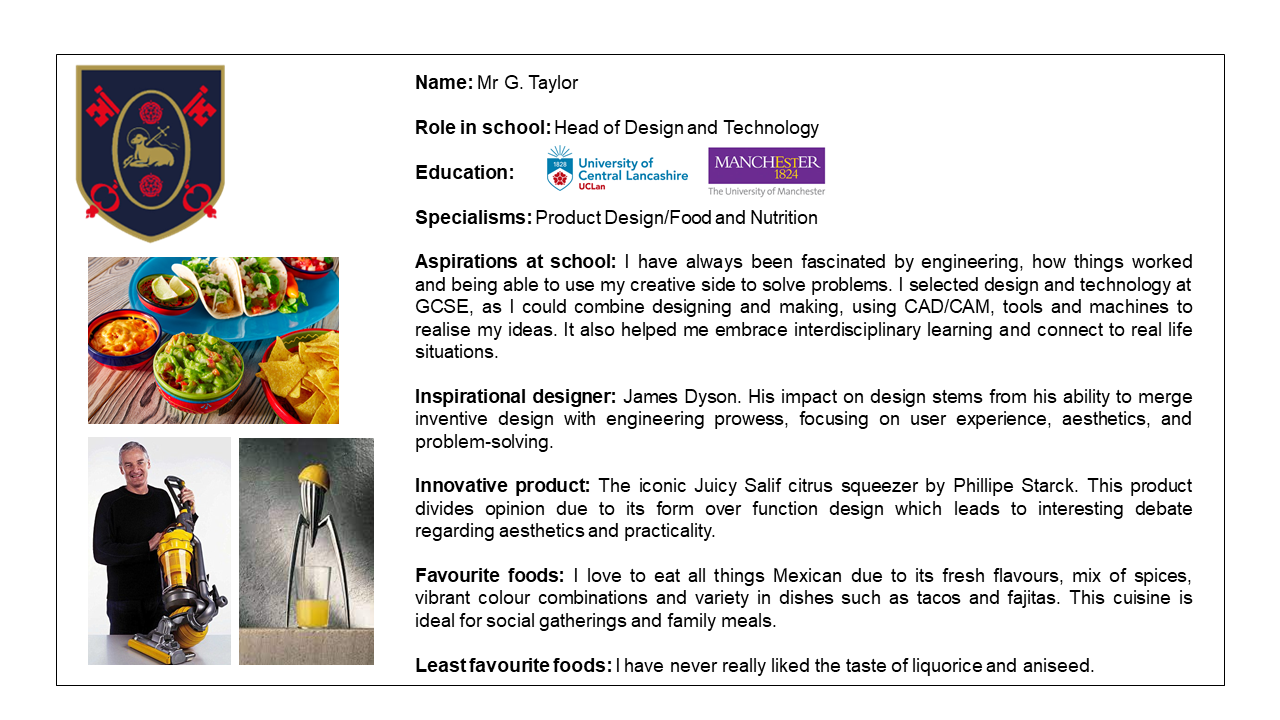
Mr G. Taylor - Head of Technology
Miss R. Parkinson - Teacher of Food Technology & Textiles
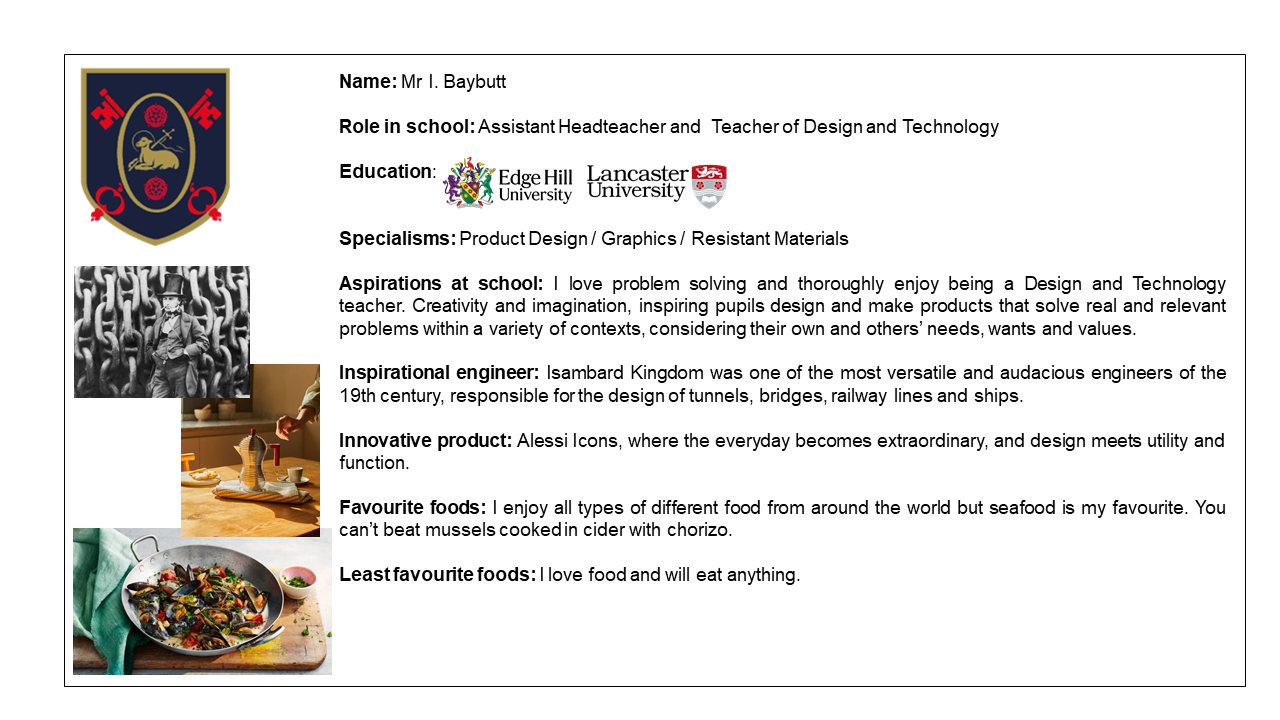
Mr I. Baybutt - Assistant Headteacher
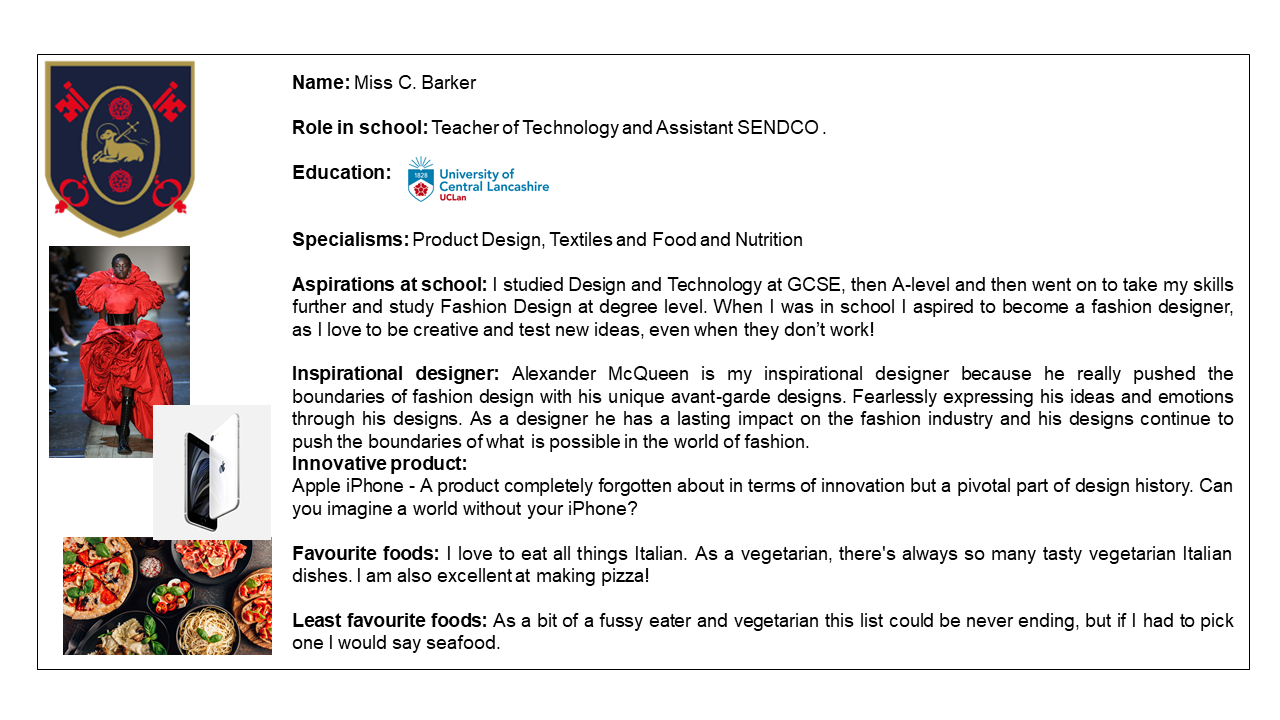
Miss C. Barker - Teacher of Design & Technology
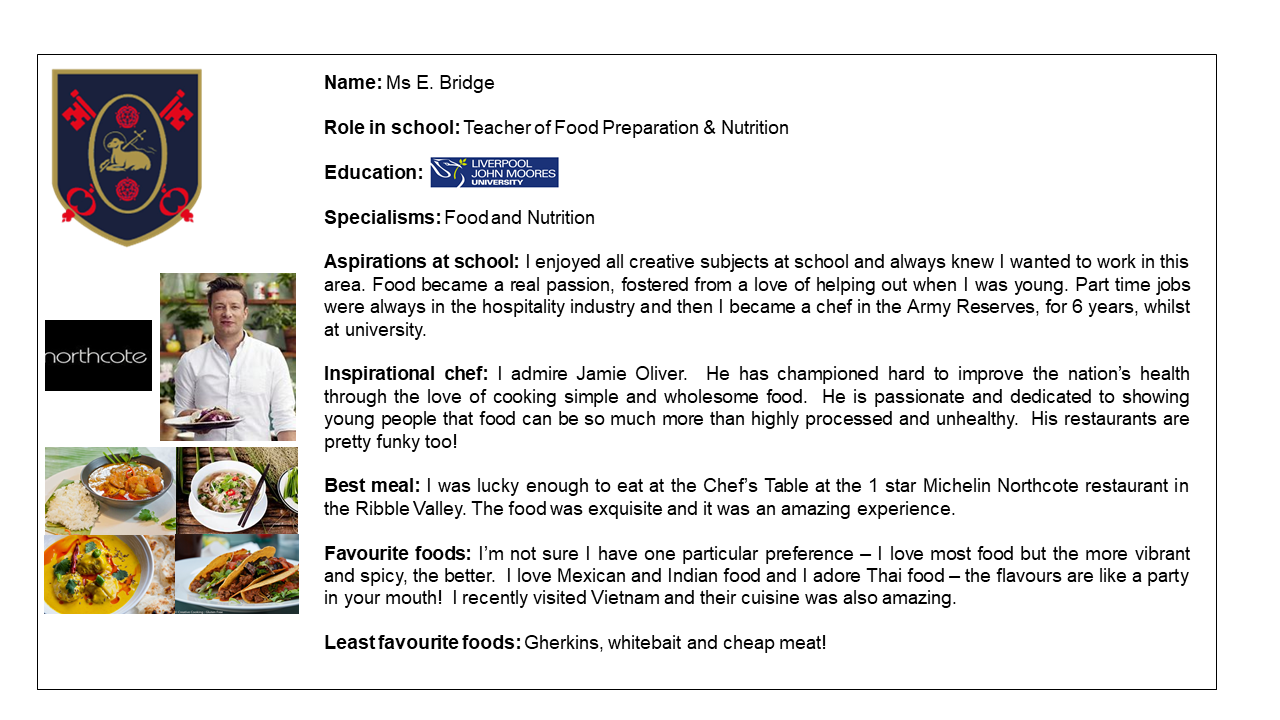
Ms E. Bridge - Teacher of Food Technology
Careers and Progression
The skills developed within Technology subjects extend far beyond the classroom. Students learn to think creatively, solve problems, manage projects, and apply technical knowledge in practical contexts.
Design skills and the ability to visualise and develop new ideas are highly transferable and can lead to careers in:
- Engineering and Manufacturing
- Construction and Architecture
- Product and Industrial Design
- Marketing, Sales and Advertising
- Arts, Crafts and Creative Industries
- Broadcast Media and Performing Arts
- Journalism and Publishing
- Hospitality and Food Industry
Technology equips students with resilience, innovation and analytical thinking — skills essential for both further education and the modern workplace.
Click on an image below and scroll through using the arrows.
Meet the Technology department