Subject: History
CURRICULUM INTENT
“To inspire young people to become wise, informed global citizens, contributing to society with integrity, respect, and hope. By understanding where we come from, we empower pupils to imagine—and help to build—a future marked by compassion, peace, and reconciliation, following the teachings of Jesus.”
The key intent of the History Curriculum at Archbishop Temple Church of England High School is to provide a high-quality education offer to pupils that will develop and expand their understanding and knowledge of their own and wider world History. We aim to create pupils who are aware and inquisitive about Preston’s place in History, as well as appreciate and engage with a variety of time periods, locations, and key figures from global history. Rooted in Christan vision and values, we ensure that pupils engage thoughtfully, critically and compassionately with the past, to understand the past and shape the future.
The curriculum is designed and constructed to inspire and engage with pupils’ curiosities to delve into the past and ask questions which are both inquisitive and perceptive. We encourage pupils to think critically, apply knowledge, assess interpretations, develop perspectives and be able to form moral judgements through our curriculum. This is with the intent and the aim to develop pupils’ communication skills and prepare them for further skills such as empathy, diversity and moral discernment. Their moral and spiritual understanding is further supported through the school values of ‘Faith, Nurture and Service’.
The curriculum is specifically designed to reduce barriers to learning* and secure strong progression for all pupils, with an extra appreciation towards relevance for pupils and the local community. For example, when pupils join us in year 7, they are met with a unit which reviews the dynamics and historical context where East meets West in Baghdad. Within this, ideas are exchanged, religions coexist, and trade flourishes. This provides an understanding of the interleaving factors between different parts of the world, such as tracking the influence of the Spice Roads from China into Europe. This then moves on to compare the importance of religion throughout time. Moving through Key Stage 3, the concepts, and dynamics of the relationship between Crown and Church are introduced. These are developed throughout Key Stage 3 when individual challenges to authority are studied, such as Becket, Magna Carta, Peasants’ Revolt, the Reformation, Elizabethan England, and the English Civil War. An investigation and exploration into the changes in power and authority, such as the strengthening of parliament and the brief interruption of the British monarchy. This idea of power and subsequent struggle is further
referred to by reviewing key examples such as the formation and establishment of trade and its links to industrialisation and Slavery. The British Empire is put under a microscope and explored, and pupils are invited to form judgements by reviewing the impact, both positive and negative of the British Empire. A range of diverse stories from across the British Empire provides different experiences and connections are revisited to tie pockets of information throughout Key Stage 3 together by analysing links through empire with trade, slavery, identity, migration, race, profit, and political power. Within this, a key focus upon the North West’s role in this is investigated through examples and topics such as the industrialisation of towns such as Preston. Social Justice is a key theme towards the end of Key Stage Three as pupils explore key examples of Black History. Our curriculum lends heavy emphasis on the impact of migration, racism, imperialism and movements with clear examples such as William Cuffey, The Civil Rights Movements in USA, The Empire Windrush, Post War Britain and the key reasons for protest through Britain and the wider world, from Peasants Revolt (1381) to Selma, Alabama (1965) and from Peterloo (1819) to the Suffragettes (1880). We ensure that our wide and diverse Archbishop Temple community feel not only represented but also appreciated. The Renaissance, The Holocaust and the impact of Commonwealth soldiers in war. Additionally, further key themes and substantive knowledge concepts in History curriculum revolve around Politics (Monarchy, Civil War, Constitution, Dictatorship), Conflict (Crusades, WWI, WWII, The Cold War), Religion (Crusades, Reformation, The Holocaust) and within each topic: key Societal changes and continuities.
Due to this integral and important Historical analysis through our curriculum – secure chronological knowledge, fluent use of disciplinary concepts pupils and the ability to construct well-reasoned, evidence informed arguments – pupils become purposeful individuals, and are able to access a range of pathways such as A-Levels, vocational qualifications and further education and employment. They also develop a lifelong engagement with History. Our pupils leave our community after 5 years, as informed, reflective, compassionate members of society; who contribute positively to their communities and wider world.
*What will you see in History lessons to help reduce barriers to learning?
Structured writing frames
Sentence stems
Hinge questions/FAME activities/Frayer models
Dual coding on slides and worksheets
Key words and vocabulary
Retrieval routines at the start of lessons
Exit tasks at the end of lessons to check understanding
IMPLEMENTATION
A variety of approaches are taken to teaching History so lessons are stimulating and engaging. Pupil voice is used and feedback from pupils reflected upon in working parties to improve the learning experience.
|
|
Autumn |
Spring |
Summer |
||||||
|
7 weeks |
8 weeks |
6 weeks |
6 weeks |
6 weeks |
7 weeks |
||||
|
Year 7 |
Unit |
Anglo-Saxons V Baghdad
|
The Norman Conquest
|
Herstory |
Power in the Middle Ages Could Medieval Kings do as they please? |
Tudors; Henry VIII & The English Reformation
|
|||
|
Assessment |
Written Assessment Similarity |
Written Assessment Interpretation, sources
|
Written Assessment Significance |
Written Assessment Similarity and difference
|
Knowledge test
|
||||
|
Skills |
Chronology, using Evidence, Change & Continuity, Significance |
Chronology, Change & Continuity Historical Enquiry: Interpretations |
Significance, change & continuity Interpretations, Source analysis |
Significance, Cause and consequence, Source analysis
|
Significance, change and continuity Interpretations |
||||
|
Year 8
|
Unit
|
Elizabethan England |
The English Civil War |
The British Empire
|
The Trade in Enslaved People |
Britain as the first industrial nation: the impact of factories |
Britain as the first industrial nation: the impact of factories
|
||
|
Assessment |
Written Assessment Source Skills
|
Written Assessment Causation
|
Written Assessment Knowledge Test |
Written Assessment Interpretation, sources
|
Written Assessment Change |
Local Study of Historic environment QBM - sources
|
|||
|
Skills |
Using Evidence Historical Concepts: Significance, change and continuity Interpretations |
Causation, Change and continuity, Chronology Consequence, Source analysis Interpretation |
Consequence, Causation Source analysis, Interpretations |
Source analysis Similarity and difference Causation |
Significance, change & continuity Interpretations |
Significance, change & continuity, Sources |
|||
|
Year 9 |
Unit |
First World War |
The inter-war years The Rise of Dictators |
Defeat of Nazism
|
Cold War
|
The Holocaust
|
Rights of The British People |
||
|
Assessment |
Written Assessment Causation |
Written Assessment Sources, Interpretation |
Written Assessment Significance |
Written Assessment Knowledge Test
|
Written Assessment Causation |
Written Assessment Similarity and difference
|
|||
|
Skills |
Cause & Consequence
|
Cause and consequence, Similarity and difference, Significance, Source analysis, Interpretation Chronology
|
Continuity and Change, Consequence, Chronology, Causation, Source Analysis Significance |
Sources, causation |
Interpretations, sources, cause and consequences |
Change and continuity, Causation, Significance, Interpretations |
|||
|
Year 10
|
Unit |
Paper 2 Britain: Power and the People Section 1
|
Paper 2 Britain: Power and the People Section 2 |
Paper 2 Britain: Power and the People Section 3 |
Paper 2 Britain: Power and the People Section 4 Paper 2: Elizabethan England Section 1 |
Paper 2: Elizabethan England Section 1 Paper 2: Elizabethan England Section 2 |
Paper 2: Elizabethan England Section 3 Paper 2: Elizabethan England Historic Environment |
||
|
Assessment |
Sample questions Past paper WTE and sample answer feedback |
Sample questions Past paper WTE and sample answer feedback |
Sample questions Past paper WTE and sample answer feedback |
Sample questions Past paper WTE and sample answer feedback |
Sample questions Past paper WTE and sample answer feedback |
Sample questions Past paper WTE and sample answer feedback |
|||
|
Skills |
Continuity, change, cause, consequence, significance, similarity and difference. |
Continuity, change, cause, consequence, significance, similarity and difference. |
Continuity, change, cause, consequence, significance, similarity and difference. |
Continuity, change, cause, consequence, significance, similarity and difference. |
Continuity, change, cause, consequence, significance, similarity and difference. |
Continuity, change, cause, consequence, significance, similarity and difference. |
|||
|
Year 11 |
Unit |
Paper 1 Germany 1890-1945 Section 1 Paper 1 Germany 1890-1945 Section 2
|
Paper 1 Germany 1890-1945 Section 2 Paper 1 Germany 1890-1945 Section 3 |
Paper 1: Conflict and tension 1918-1939 Section 1 Paper 1: Conflict and tension 1918-1939 Section 2 |
Paper 1: Conflict and tension 1918-1939 Section 2 Paper 1: Conflict and tension 1918-1939 Section 3 |
Paper 1: Conflict and tension 1918-1939 Section 3 Revision |
|
||
|
Assessment |
Sample questions Past paper WTE and sample answer feedback |
Sample questions Past paper WTE and sample answer feedback |
Sample questions Past paper WTE and sample answer feedback |
Sample questions Past paper WTE and sample answer feedback |
Sample questions Past paper WTE and sample answer feedback |
|
|||
|
|
Skills |
Continuity, change, cause, consequence, significance, similarity and difference. |
Continuity, change, cause, consequence, significance, similarity and difference. |
Continuity, change, cause, consequence, significance, similarity and difference. |
Continuity, change, cause, consequence, significance, similarity and difference. |
Continuity, change, cause, consequence, significance, similarity and difference. |
|
||


Programmes of Study
Year 7
The Anglo-Saxons, The Norman Conquest, Herstory, Power in Medieval England, Tudors; Henry VIII & The English Reformation.
Year 8
Elizabethan England, The English Civil War, Empire, The transatlantic slave trade: effects and abolition, The Industrial Revolution, Local History study Quarry Bank Mill.
Year 9
Year 9 – First World War, Rise of the Dictators, Defeat of Nazism, the Holocaust, Minority Rights in the 20th century
Click here to view the Year 9 Options information for History.
Year 10
Thematic Study: Power and the People, Elizabethan England; 1568-1603
Year 11
Germany 1890−1945: Democracy and Dictatorship, Conflict and Tension 1918−1939
IMPACT
Marking and Assessment
Five Year curriculum.
Exercise books are for pupils to take down class notes and express their learning and develop thoughts. Therefore, the marking of class work is not required so is not routine practice. Two pieces of identified work are marked by the teacher every half term with feedback given. Pupils are then given ‘Time to Improve’ tasks based on the feedback. Formative assessment takes place every lesson where teachers check pupil understanding, misconceptions and identify gaps; reteach follows if required. Formal assessment occurs at the end of units and assesses skills and knowledge. This includes a formal end of year assessment.
Home learning tasks are set weekly/ fortnightly, and shorter tasks will be marked by the teacher or peer/ self-assessed using green/purple pen. General and specific comments are given for pupils to then self/ peer correct. At GCSE extended writing is set once a week and shorter tasks once a week also.
Modelling of marking and feedback on home learning is done in detail to the whole class. Key ideas/ theories and misconceptions are then highlighted and corrected onto pupil work. Feedback is verbal and this is to the whole class, but individuals may be highlighted too.
At KS3 Assessment feedback sheets are used for all formal assessments which give quantifiable feedback.
Within KS4 assessments pupils are awarded a mark according to GCSE criteria along with specific feedback on how to improve. Written work will have teacher annotation, comments, advice and/or targets for pupils, if appropriate. We are consistent in regular monitoring using a variety of methods to assess learning, E.G. peer and self-assessed marking. Outstanding marking will encourage the use of subject specific vocabulary and applied knowledge and skills.
Examinations
At GCSE pupils are tested on the current topic for end of unit tests, knowledge and exam based. Pupils will also start a new topic by revisiting the previous topic using a knowledge test.
Revision Guides / Resources
All lessons are linked on Synergy to pupils’ timetables and revision guides have been created to support GCSE pupils.
Staff Details
Mrs Charlotte Marsden (Curriculum Leader for History)
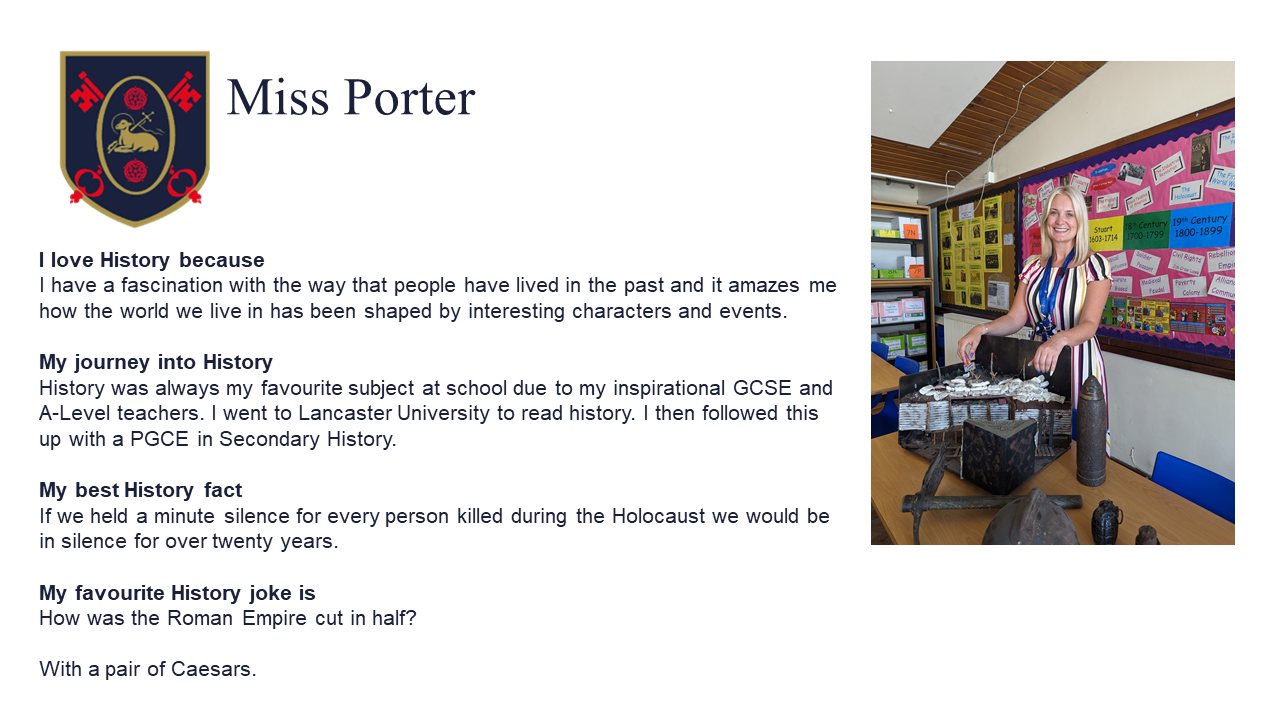
Miss Sarah Porter (Teacher of History and Head of Year 11)
Mr John Johnson (Teacher of Humanities and Head of Year 10)
Careers and Progression
Any career will welcome History as a GCSE! Our curriculum model is a skilfully sequenced, broad and coherent knowledge pathway, which leads students to success at GCSE and A-Level.
As a student of History all pupils are taught to challenge evidence and identify bias. These skills are useful in the in the following career pathways; Law, politics, Business, marketing and economics.
Click on an image below and scroll through using the arrows.
Meet the History Department