CURRICULUM INTENT

The Religious Education curriculum at Archbishop Temple Church of England High School is rooted in the school’s Christian vision. Through the study of religion and worldviews, we seek to enable all pupils to flourish and let their light shine, developing wisdom, compassion and discernment needed to engage confidently with the world around them.
As a Church of England school, Christianity lies at the heart of our curriculum and is explored as a diverse, living and global faith which is expressed through a variety of traditions, cultures and interpretations. Pupils develop deep knowledge and understanding of Christian beliefs, teachings and practices alongside the study of other major world religions and non-religious worldviews. Through engagement with sacred texts, theology, philosophy and ethics, pupils encounter the richness and diversity within and between traditions and consider how beliefs shape identity, community and society. Pupils engage with religion and worldviews through theological, philosophical and social scientific approaches, enabling them to understand both beliefs and the lived experiences of individuals and communities.
Our curriculum aims to develop religiously literate young adults who possess both knowledge and wisdom, enabling them to think critically, reflect deeply and engage respectfully with different beliefs and perspectives. Pupils are encouraged to ask challenging questions about meaning, purpose, truth and morality whilst developing the confidence to articulate and reflect upon their own beliefs and values. In doing so, we seek to nurture wisdom, dignity, empathy and hope within our school community.
Religious Education at Archbishop Temple is academically rigorous and informed by evidence-based practice. Deep and lasting learning is supported through the careful sequencing, revisiting and retrieval of knowledge and disciplinary skills. Through interleaving, low-stakes retrieval practice and opportunities for extended discussion and evaluation, pupils deepen their understanding and grow in confidence over time.
Through the RE curriculum, pupils learn to analyse and evaluate religious, philosophical and ethical issues with increasing sophistication. Classroom dialogue encourages pupils to be enquiring, respectful and open-minded, preparing them to contribute positively to modern Britain and the wider global community. In keeping with the school’s ethos of faith, nurture and service, we encourage pupils to recognise their responsibility towards others and to become courageous advocates for justice, compassion and the common good.
Beyond the classroom, pupils are offered a range of enrichment opportunities including guest speakers, visits, extra-curricular activities, podcasting, leadership opportunities and engagement with local schools and faith communities. These experiences deepen pupils’ understanding of lived faith and enable them to apply their learning beyond the classroom and to let their light shine through service, reflection and meaningful engagement with the world around them.
Loving God,
Guide us to greater wisdom through our learning in RE. Enable us to develop a greater appreciation of our own faith, and a better understanding of the faith of others. Give us courage to put our faith into action.
Amen.
IMPLEMENTATION
Archbishop Temple School’s Religious Education Department’s 5-year curriculum 2026-2027
|
|
Autumn |
Spring |
Summer |
||||||||||||||
|
Year 7 |
What does it mean to be a person of faith? Pupils learn about the basic beliefs and practices of the six main world religions (Judaism, Christianity, Islam, Hinduism, Sikhism & Buddhism) and are introduced to Humanism. |
Why are Holy Week and Easter important? Pupils examine Jesus’ suffering, death and resurrection and what Christians believe about it. |
How did Christianity become a global religion? Pupils look at how Christianity spread throughout the world and how diverse Christianity is.
|
Where do people go to find affirmation of faith? Pupils learn about a range of pilgrimage sites: why they are places of pilgrimage and what rituals take place there. |
|||||||||||||
|
Year 8 |
What does it mean to be Muslim? Pupils learn the key beliefs and practices of Islam and think about what it means to be a Muslim in Britain today. |
How should we treat people? Pupils explore Christian values and how these impact on the treatment of people. |
What is the evidence for life after death? Pupils explore different beliefs about life after death. They consider the significance of funerals and how different cultures respond to remembering the dead. |
Why do people believe in God? What do people believe about God? Pupils examine arguments for and against the existence of God. They will look at Christian concepts of God, including the Trinity. |
|||||||||||||
|
Year 9 |
What does it mean to be called? Pupils will look at Biblical and modern-day examples of being called by God. They will explore the idea of vocation and what that means to different people. |
What does it mean to be a good steward? Pupils will learn about Christian teaching on stewardship and their responsibility to look after the world. |
What does it mean to be a Buddhist? Pupils learn the key beliefs and practices of Buddhism and think about what it means to be a Buddhist. |
How visible are religious beliefs and worldviews? Pupils will explore the impact that faith has on society in general. They will look at recent data, and explore mediums such as art, music and literature.
|
What does it mean to be Jewish? Pupils learn the key beliefs and practices of Judaism and think about what it means to be a Jewish person in Britain today. Links will also be made with their History topic on the Holocaust. |
||||||||||||
|
Year 10 |
GCSE Introduction Focuses on key Christian teachings that are used throughout the course |
Paper 1 Christianity: Beliefs and Teachings |
Paper 1 Christianity: Practices
|
Paper 1 Islam: Beliefs and Teachings Islam: Practices |
|||||||||||||
|
Year 11 |
Paper 1 Islam: Practices |
Paper 2 Theme B Religion and Life |
Paper 2 Theme A Relationships and families |
Paper 2 Theme D Religion, Peace and Conflict |
Paper 2 Theme E Religion, Crime and Punishment |
|
|||||||||||
|
Key Stage 3 Curriculum is based on Blackburn Diocese Illuminating Pathways Religious Education Programme. GCSE Course AQA Religious Studies Specification A: Christianity, Islam and Themes Assessments take place throughout the courses in a variety of formal and informal ways with a focus on memory retention and regular low-stakes testing. Retrieval of previous topics takes place throughout the curriculum. This may be particularly evident in Years 10 and 11 where this may form significant parts of lessons, taking pupils away from the planned topic in order to practice long-term memory and further deepen previous learning. |
|||||||||||||||||
IMPACT
Marking and Assessment
Pupils will receive regular age and stage appropriate assessments. Verbal feedback is regular and key assessments receive more detailed written and verbal feedback. The purpose of assessment is to inform pupils, parents and teachers of the progress and security of learning, to encourage pupils to improve their work and to enable them to do so.
Examinations
During Key Stage 3, pupils undertake formal examinations as well as key assessments. Key Stage 4 assessments prepares pupils for two GCSE examinations for the award of AQA Religious Studies GCSE grade 9-1.
Paper 1 – Christianity and Islam – 1 hour 45 minutes – 50% of overall grade.
Paper 2 – Themes without textual studies – 1 hour 45 minutes – 50% of overall grade.
Revision Guides / Resources
AQA Revision Guide – Religious Studies A (9-1) Christianity and Islam.
CGP GCSE AQA A Religious Studies for the Grade 9-1 course.
Staff Details
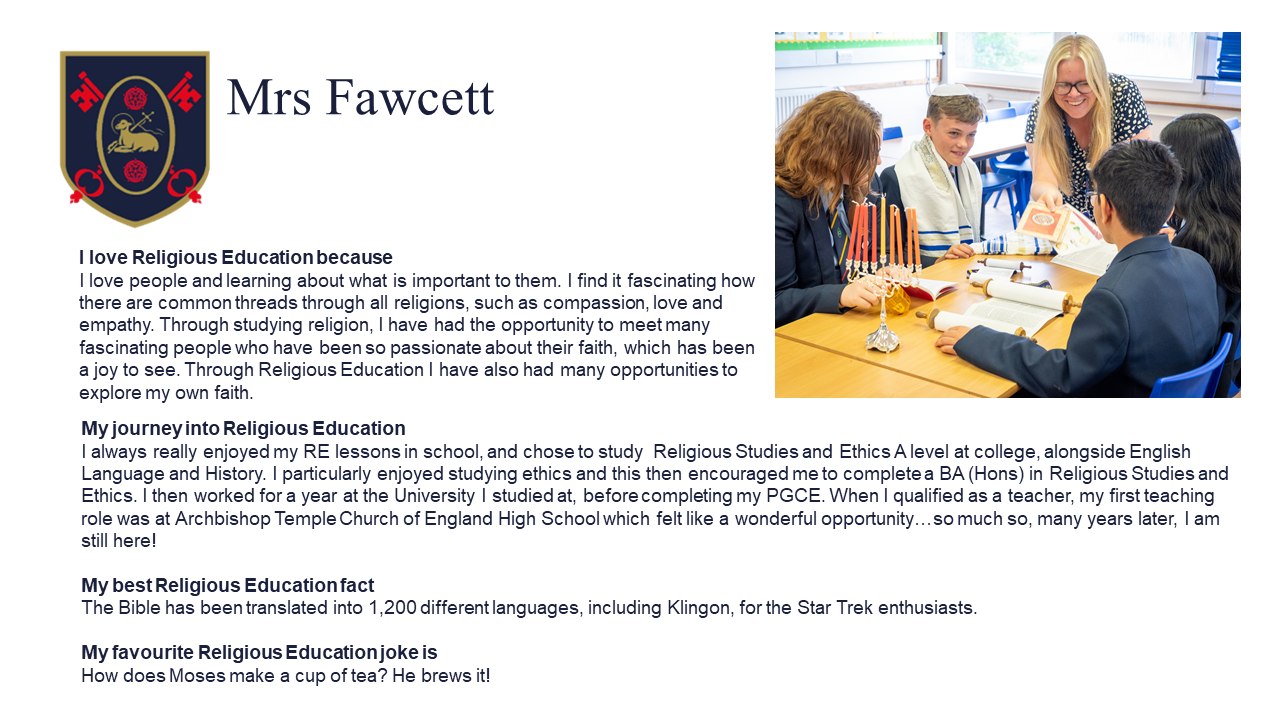
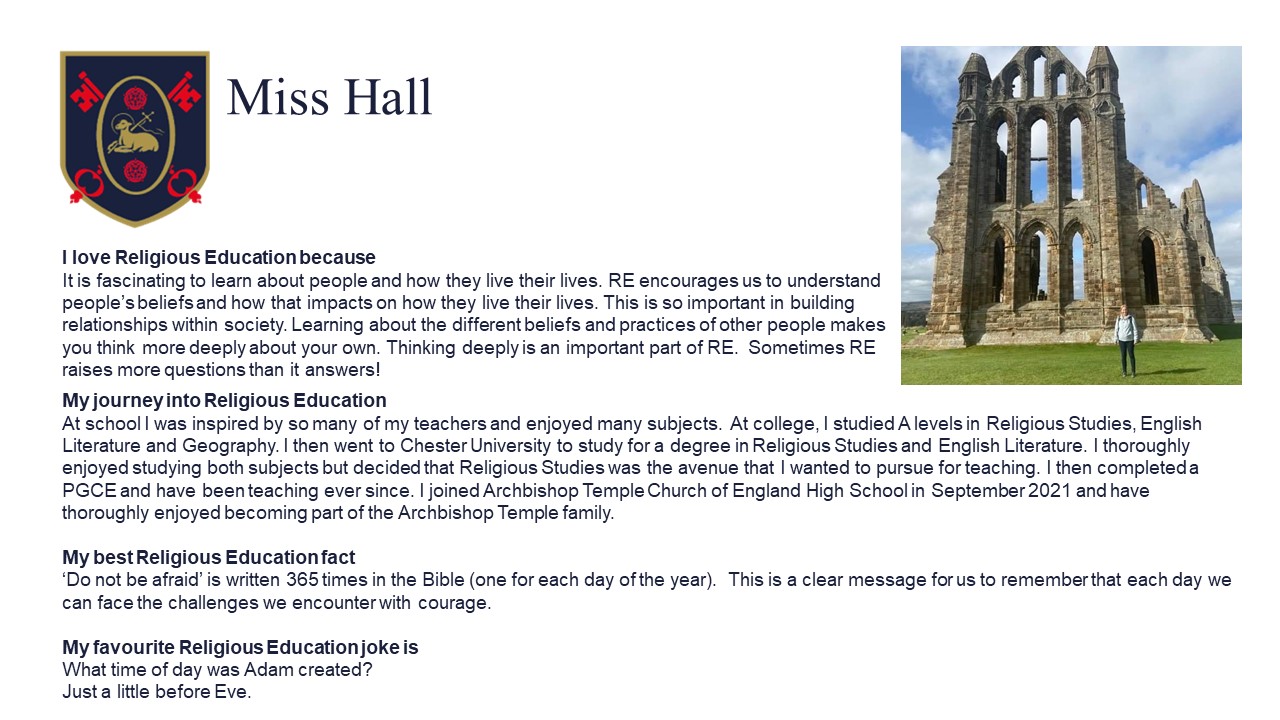
Miss R Hall – Head of Department
Mrs G Fawcett – Second in Department
Mrs R Metcalfe - Teacher of Religious Education and PSHE Lead
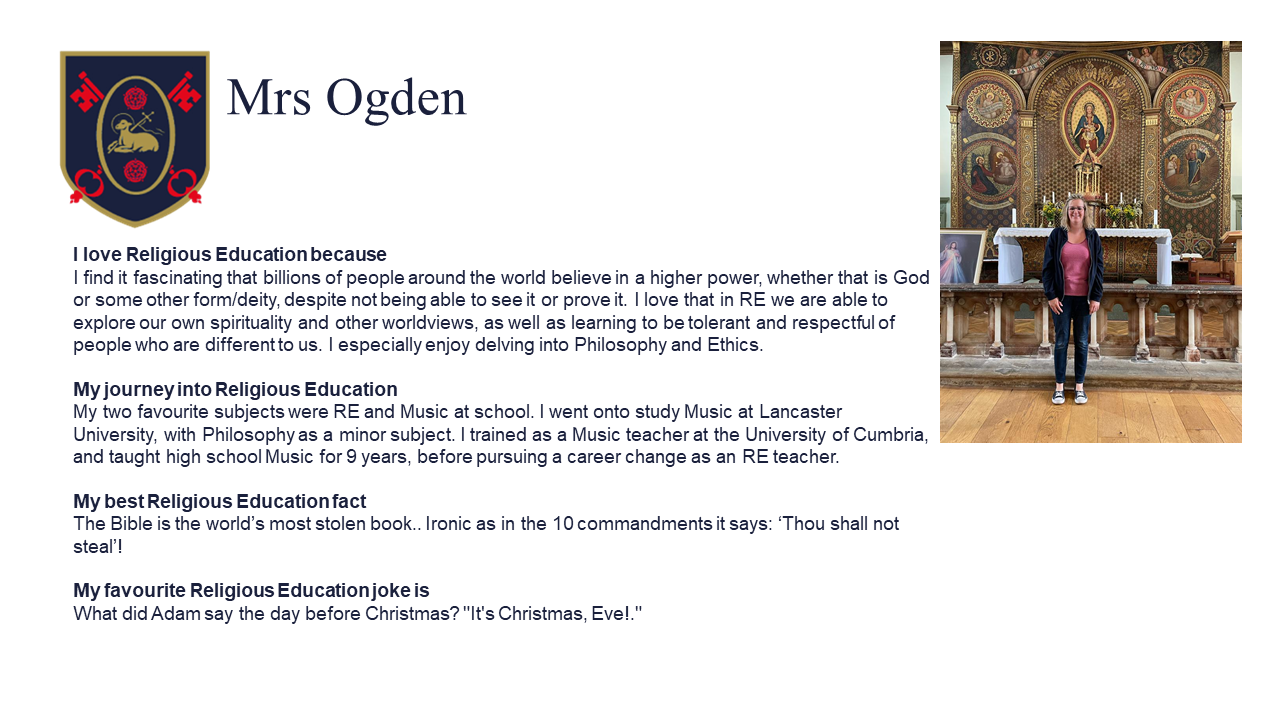
Mrs L Ogden – Teacher of Religious Education
Mrs Gardner - Teacher of Religious Education
Careers and Progression
Studying Religious Education at GCSE provides an excellent foundation for further academic study in related disciplines such as Philosophy, Theology, Ethics, Law, Nursing, Politics. It can provide invaluable life skills and develop skills in critical thinking and ethics. Its principles are valued in a range of people related professions where ethical and compassionate decision making is required including teaching, nursing, law, medicine and social work/care. Knowledge of other cultures and world religions can be useful in many jobs where you are working with the public or communities. These include counselling and social services, marketing, sales and advertising, catering and hospitality, leisure, sport and tourism, retail sales and customer services, and service sector roles.
Watch this short film to find out how studying Religious Education at GCSE and A Level provides you with important life skills and offers opportunities in further education and a wide variety of careers.
Meet the Religious Education Department
Mrs Gardner
I love Religious Education because:
I love RE because it connects perfectly with my passion for travel and culture. I’m fascinated by the different ways people worship around the world, and I’ve been lucky enough to experience this first-hand—from Vatican City and the Salt Lake Tabernacle to the breathtaking Taj Mahal. I’ve also visited stunning mosques in the United Arab Emirates and the unique 'floating' mosque on Ko Panyi. RE brings these experiences to life and helps deepen understanding of beliefs, traditions, and communities across the globe. I love sharing these real-life experiences, stories, and photos with my pupils to spark their curiosity and help them see the world through a broader, more understanding lens.
My Journey into RE
My journey into teaching RE began with many years of teaching English, during which I quickly realised that you can’t fully understand a text without appreciating the wider context—its culture, the writer’s beliefs, and the religious influences shaping both the author and the setting. Literature opened the door to deeper questions about identity, tradition, and worldview. Over time, this naturally evolved into a passion for exploring those ideas more directly, and I’ve since channelled my love of literature and culture into teaching RE, where those connections come to life in an even richer and more meaningful way.
My best Religious Educational fact:
In William Shakespeare's time, it was illegal to be Catholic. It is believed that Shakespeare’s family were secret Catholics – the secret Catholics were called “recusants”, which means “refusers”, because they refused to conform to the state religion
My Favourite Religious Education joke is:
Why did the Sunday school teacher bring a ladder to class?
Because they heard the lesson would be uplifting
Mrs Higginson
I love Religious Education because it gives us an opportunity to learn about other people and what is important to them. I strongly believe that RE is important within schools and the community as it is a way to promote respect, tolerance and community cohesion in our diverse society. Religious education can help us reflect on how we can make a positive difference to the wider world and help people connect with each other.
My journey into Religious Education.
Religious Education was my favourite subject at school. I completed my A levels in Sociology, Psychology and Law and completed my degree in Criminology. Whilst at university I completed voluntary work within schools and Youth Offending services and I knew I wanted to work with young people. I worked within a Secondary school in Blackburn for a year- where I met my husband and then returned to University to study PGCE in Religious Education. I joined the Archbishop Temple in 2025 and have loved being part team!
My best Religious Education fact
The Bible is the best-selling book in history, with total sales exceeding 5 billion copies
My favourite Religious Education joke
Who do mice pray to?
Chessus
Mrs Metcalfe
I love Religious Education because:
I love Religious Education because it helps young people to understand the world we live in. RE gives pupils the opportunity to explore different beliefs, cultures, values and perspectives, while developing the confidence to think critically and make informed choices for themselves.
Alongside teaching RE, I also lead PSHE, and I am passionate about the role both subjects play in developing well-rounded, confident and compassionate young people who are ready to flourish in modern Britain. I want pupils to have a curiosity about the wider world and a desire to experience, explore and understand the people, cultures and communities within it.
Outside school, I am actively involved in my local parish, where I help to run children’s worship, organise events and activities and work closely with the local primary school. This has allowed me to see first-hand how faith can positively impact a community, bringing people together and providing a sense of belonging, purpose and comfort.
My journey into Religious Education:
I studied Sociology and Social Policy at the University of Leeds and always knew that I wanted to be teach about the world we live in. Religious Education was a subject I found fascinating because of how relevant it is to everyday life and the world around us.
I completed my teacher training at Edge Hill University in 2012–2013 and have since had the opportunity to work with some fantastic organisations and institutions, including the Anne Frank Trust, Edge Hill University and the Duke of Edinburgh’s Award.
I was particularly drawn to Archbishop Temple because of the ethos of the school and its commitment to developing the whole person. This closely reflects my own approach to education: helping young people develop not only knowledge, but also the values, confidence and understanding they need to flourish.
My best Religious Education fact:
During the Second World War, St Paul’s Cathedral survived the Blitz despite suffering direct bomb hits. The sight of its famous dome still standing above the smoke and destruction of London became a powerful symbol of hope and resilience.
My favourite Religious Education joke:
Why did the Wise Men bring gifts to Jesus?
Because you should never turn up to a birthday party empty-handed!
At Archbishop Temple, Religious Education extends beyond the classroom through a rich programme of enrichment opportunities that enable pupils to encounter religion and worldviews as lived realities. These experiences deepen curriculum learning, support spiritual and personal development, and encourage pupils to let their light shine through service, reflection and engagement with the wider community.
Many activities are linked directly to the curriculum, while others connect with wider school initiatives, including Eco Club, chaplaincy events, and community outreach projects. Together, these experiences help pupils develop knowledge, empathy, leadership skills, and a greater appreciation of the role religion and worldviews play in society.
Enrichment at a glance:
- Visits to places of worship
- Encounters with faith communities
- Guest speakers and personal testimonies
- Pilgrimage experiences
- Community service projects
- Eco-club and stewardship initiatives
- Faith sharing and leadership opportunities
- Collaboration with local schools
Below are some examples of the enrichment opportunities available to our pupils.
Year 7 Visit to Blackburn Cathedral and Noorul Islam Mosque


As part of the Year 7 Religious Education unit, What does it mean to be a person of faith?, and as a key element of the Year 7 induction programme, all pupils visit Noorul Islam Mosque and Blackburn Cathedral. The visit provides an invaluable opportunity for pupils to encounter faith as it is lived and practised within both Muslim and Christian communities.
At Noorul Islam Mosque, pupils learn about the beliefs and practices of Islam through presentations and discussions led by members of the local Muslim community. They explore the key features of a mosque, observe demonstrations of prayer, learn about the significance of wudu (ritual washing), and are encouraged to ask questions. These experiences help pupils to develop a deeper understanding of Islamic beliefs and practices while challenging misconceptions and promoting respect for diversity.

At Blackburn Cathedral, pupils explore the history, symbolism, and architecture of the
cathedral, gaining insight into the role of the Church within the Diocese of Blackburn. Through a range of reflective activities, pupils are encouraged to consider different expressions of Christian faith and spirituality. The visit provides opportunities for personal reflection and helps pupils appreciate the importance of sacred spaces within religious life.

By visiting both places of worship, pupils develop their understanding of religion as a lived experience, deepen their knowledge of Christianity and Islam, and strengthen their ability to engage respectfully with people of different faiths and worldviews.
Jewish Visitors
Jewish visitors, including relatives of Holocaust survivors, work with Year 7 and Year 9 students as part of the Religious Education curriculum, supporting the units What does it mean to be a person of faith? and What does it mean to be Jewish?
Through hearing powerful personal testimonies and engaging in discussion, pupils gain a deeper understanding of Judaism as a lived faith and explore how religious beliefs, traditions, and identity shape individuals and communities. The opportunity to meet members of the Jewish community brings learning to life, helping pupils to move beyond textbook knowledge and develop empathy, respect, and understanding.
For Year 9 pupils, hearing the experiences of relatives of Holocaust survivors provides a particularly meaningful insight into the impact of prejudice, discrimination, and persecution. These encounters encourage pupils to reflect on the importance of remembrance, human dignity, and standing against intolerance in all its forms.
By engaging with authentic voices and lived experiences, pupils develop a richer understanding of Jewish belief and practice while strengthening their ability to appreciate and respect different faiths and worldviews.
Vocation and Calling: Year 9 Guest Speakers
As part of the Year 9 Religious Education unit What does it mean to be called?, pupils have the opportunity to meet a range of guest speakers who share their experiences of vocation and service. These encounters help pupils to explore how individuals respond to a sense of calling and how faith can influence life choices, careers, and commitments.
We regularly welcome speakers from local Christian communities, including clergy, youth workers, and chaplains. Through hearing first-hand accounts, pupils gain insight into the diverse ways people live out their faith in service to others.
Our school chaplain, Jo, shares her personal vocation journey, explaining how her faith led her to work within education while also training for ordained ministry. Darren Highton from the Salvation Army also visits regularly, speaking about his work supporting vulnerable members of the community and reflecting on how he came to recognise and respond to his calling.
These sessions encourage pupils to reflect on their own gifts, talents, and aspirations while considering the role that faith, values, and service can play in shaping a meaningful life. Through discussion and questioning, pupils gain a deeper understanding of vocation as both a religious concept and a personal journey.

Ladyewell Pilgrimage Trip
The visit to Ladyewell Shrine in Preston is a curriculum-linked enrichment opportunity for Year 7 pupils, supporting the Religious Education unit Where do people go to find affirmation of faith? Through this experience, pupils explore the significance of pilgrimage within Christianity and gain a deeper understanding of how places of worship and devotion can strengthen and sustain faith.

During the visit, pupils take part in a mini-pilgrimage experience at one of England's oldest Catholic pilgrimage sites, engaging with over 500 years of Christian history, tradition, and devotion. They learn about the shrine's importance to pilgrims, participate in moments of reflection, and consider why sacred places continue to hold meaning for believers today.
Pupils selected as representatives from each class are encouraged to share their experiences with their peers on their return to school. This not only deepens their own understanding of pilgrimage and faith but also enables them to enrich the learning of others. Through the visit, pupils develop a greater appreciation of lived religion and reflect on the role that community, tradition, and spiritual experience play in the lives of believers.
Eco-Club
Eco-Club is a cross-curricular enrichment opportunity open to pupils in all year groups. Through a range of practical activities, pupils are encouraged to take an active role in caring for the environment and promoting sustainability within the school community.
Members of the club participate in projects such as planting, fruit harvesting, recycling initiatives, and awareness campaigns, helping to create a greener and more environmentally responsible school. Each year, pupils also attend the local Schools Eco Conference, where they have the opportunity to learn from experts, share ideas, and collaborate with other schools on environmental issues.

The work of Eco-Club supports Religious Education by enabling pupils to explore the concept of stewardship and the responsibility humans have to care for creation. Through their involvement,
pupils are encouraged to reflect on how faith, values, and ethical responsibility can inspire positive action for the common good.
By taking part in Eco-Club, pupils develop leadership skills, environmental awareness, and a deeper understanding of their role as responsible citizens, both within the school community and beyond.
Blue Flamingo Café

This year, the Pupil Council explored ways to support vulnerable people beyond school and developed a partnership with Blue Flamingo, a charity that supports people living with dementia and their carers. Through regular visits to the Blue Flamingo café at St Michael and All Angels Church in Ashton, pupils spend time chatting, playing games, and serving refreshments to members of the community.
The Blue Flamingo partnership supports themes explored throughout the Religious Education curriculum, including service, community, human dignity, compassion, and social responsibility. Through serving others and building relationships with vulnerable members of the community, pupils are encouraged to reflect on Christian teachings about loving one's neighbour and putting faith into action.
Pupil Sharing of Faith
Each year, Mrs Fawcett accompanies a group of pupil representatives from a range of faith backgrounds to St Andrew's Primary School, where they speak to Year 5 pupils about their beliefs, practices, and experiences of faith. This provides a valuable opportunity for pupils to share their personal perspectives and act as ambassadors for their faith communities.
Through presentations, discussion, and question-and-answer sessions, pupils help younger learners to develop a greater understanding of religious diversity and the ways in which faith can influence daily life. By sharing their own experiences, pupils demonstrate that religion is not simply something studied in the classroom but a lived reality that shapes identity, values, and belonging.
The experience also enables pupils to develop important leadership, communication, and oracy skills. Speaking confidently about matters of faith encourages pupils to reflect more deeply on their own beliefs while learning how to engage respectfully in dialogue with others.
This enrichment opportunity supports key themes explored throughout the Religious Education curriculum, including identity, community, diversity, and what it means to be a person of faith. It encourages pupils to appreciate both the similarities and differences between religious traditions and promotes mutual understanding and respect within the wider community.
Through a wide range of enrichment opportunities, pupils are able to experience religion and belief beyond the classroom. Encounters with faith communities, places of worship, charities, and individuals of faith enable pupils to deepen their understanding of key curriculum themes, including identity, belonging, vocation, service, stewardship, and community. These experiences help pupils to become reflective, respectful, and compassionate individuals who are prepared to engage positively with a diverse society.